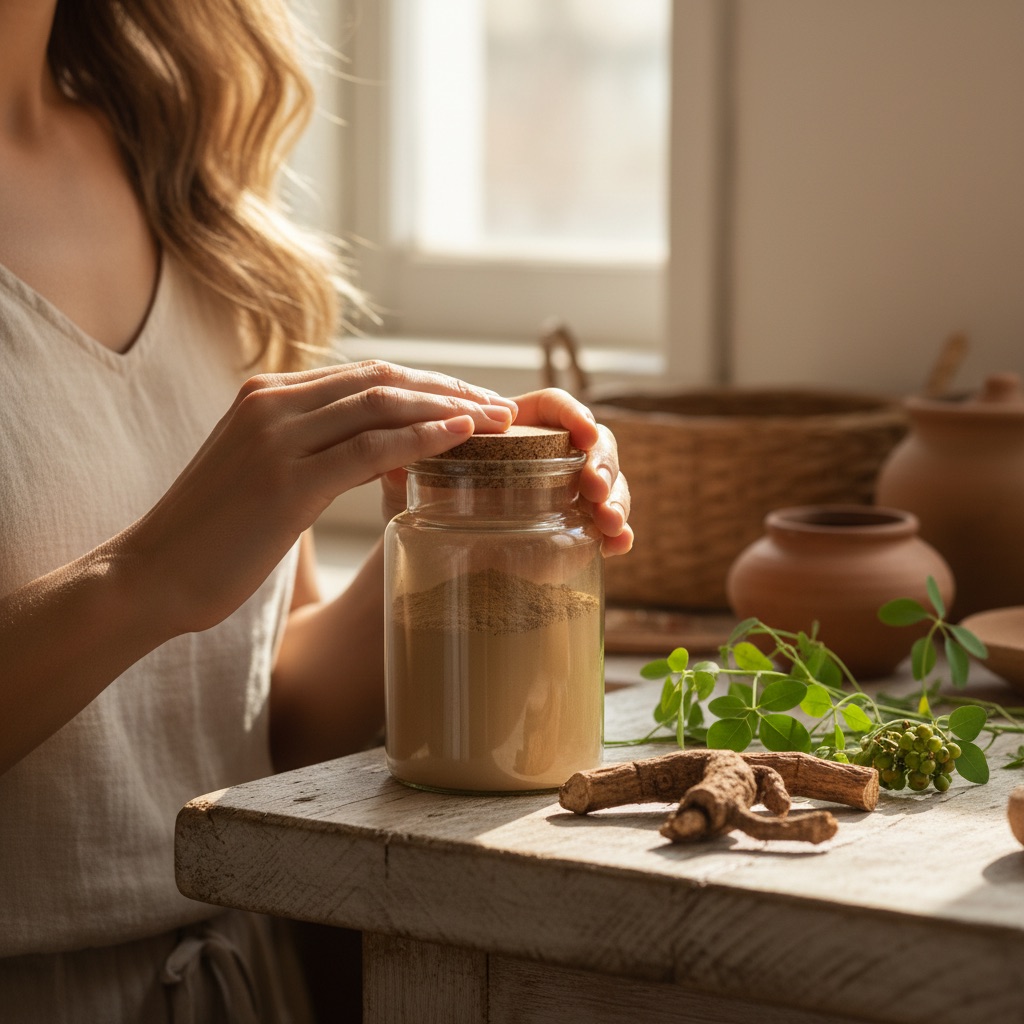
There is a quiet problem on the ashwagandha shelf, and it is not whether the herb "works." It is that two bottles sitting side by side, both labelled "ashwagandha," both around the same price, can contain genuinely different things — a root-only extract standardized one way, a root-and-leaf extract standardized another, or a cheap milled powder hiding inside a proprietary blend. The front labels rarely make the difference legible, and that is exactly where money gets wasted.
This guide fixes that. By the end you should be able to pick up any ashwagandha product, work out which extract you are actually buying, judge whether its potency and dose are honestly disclosed, and decide if it deserves your money — plus know the safety facts that matter more here than with most supplements. We do not rank specific products, because we have not tested them yet, and a ranked list of bottles nobody opened is the thing we built this site to avoid. What you get is the method, so you can judge any bottle yourself.
A note first: this is shopping guidance, not medical advice. Ashwagandha is sold as a dietary supplement, and the FDA does not approve supplements for safety or effectiveness before they are sold the way it does prescription drugs (FDA). Ashwagandha also carries real safety considerations — including a liver-injury signal and a list of people who should avoid it — so the safety section near the end is not boilerplate. If you take medication, are pregnant or breastfeeding, have a thyroid or autoimmune condition, or have a surgery scheduled, talk to your clinician before starting.
Does ashwagandha actually do anything?
Honestly: the evidence is promising in places and thin in others. The U.S. government's National Center for Complementary and Integrative Health summarizes it carefully — "research shows that some ashwagandha preparations may be effective for insomnia and stress," while the evidence for anxiety "remains unclear" (NCCIH). One of the most-cited trials, a randomized, double-blind, placebo-controlled study of 64 chronically stressed adults, gave 300 mg of a high-concentration root extract daily for 60 days and reported significantly greater improvements in stress and anxiety scores than placebo (Chandrasekhar 2012, Indian J Psychol Med). Encouraging — but NCCIH flags the catch that should shape how you shop: "many of the studies have had small sample sizes and have used a variety of ashwagandha preparations." In other words, a result from one standardized extract at one dose does not automatically transfer to a different one in a different bottle.
That single fact is why the extract you choose matters. Ashwagandha is not one product; it is a category of preparations that differ in plant part, extraction method, and concentration. So the realistic question is not "does ashwagandha work" — it is "if I am going to try it, how do I buy a version that is honestly made, matches what was actually studied, and is safe for me?" For the broader label-reading method that applies to every adaptogen, our adaptogen buying guide is the parent of this one; here we go deep on the decision that guide only names in passing.
The decision the front label hides: which extract you're buying
Most reputable ashwagandha sold today is one of three branded, standardized extracts. They are not interchangeable, and knowing which one is in your hand is the single most useful thing you can read off a label.
| Extract | Plant part | Standardized to | What that means for you |
|---|---|---|---|
| KSM-66 | Root only | ~5% withanolides (min) | Largest clinical research base; root-only profile; taken at a higher dose because the concentration is lower |
| Sensoril | Root + leaf | ~10% withanolides | Water-based extract; higher withaferin-A from the leaf; lower dose; often studied for sleep/stress |
| Shoden | Root + leaf | ~35% withanolide glycosides (HPLC) | Highest concentration; taken at the lowest doses; newer, smaller evidence base |
A few things follow from that table, and they are the points worth internalizing:
- A higher withanolide percentage is not "stronger" in a way that helps you compare prices. A 35% root-and-leaf extract is more concentrated than a 5% root-only one, so it is dosed lower — the percentage and the dose move together. Comparing percentages alone, without the milligrams, tells you almost nothing.
- Root-only and root-and-leaf are different phytochemically. Ashwagandha leaf is richer in withaferin-A relative to the other withanolides, so a root-and-leaf extract is not just "more of the same" — it is a different mix. Traditional Ayurvedic use centred on the root, which is part of why KSM-66 markets its root-only sourcing.
- The biggest evidence base sits with KSM-66, simply because it has been studied the most. That is a reason to prefer the extract the research used for the outcome you care about, not a verdict that one brand is universally superior.
These specifications come from the extract makers' own published standards, and that is the point: a product using a real branded extract will name it, because naming it is how the maker proves provenance. A bottle that just says "ashwagandha extract" with no named extract and no withanolide figure has told you nothing you can verify.
What the doses — and the real cost — look like
Because the extracts are concentrated differently, they are taken at very different amounts, and that — not the sticker price — is what tells you whether you are overpaying.
| Extract | Amount used in studies | Why |
|---|---|---|
| KSM-66 (root, ~5%) | ~300–600 mg/day | Lower concentration, so more material per dose; the well-known stress trials used 300 mg once or twice daily |
| Sensoril (root+leaf, ~10%) | ~125–250 mg/day | Roughly twice the withanolide concentration, so a smaller dose |
| Shoden (root+leaf, ~35%) | ~60–120 mg/day | The most concentrated, taken in the smallest amounts |
These are the amounts used in clinical studies, not a dose recommendation — confirm yours with a clinician, especially if you take other medication. And keep NCCIH's caveat in view: those amounts were paired with one specific extract in one study, and do not transfer automatically to a different preparation.
The cost lesson follows directly. A bottle is not cheap or expensive by its shelf price — it is cheap or expensive by what you pay per milligram of standardized withanolides, from a named extract, with a verifiable seal. A $15 bottle of an anonymous "extract" with no named standardization and no visible dose can be the more expensive purchase, in the only sense that matters, than a $30 bottle of a named extract whose milligrams you can actually see. Price tells you almost nothing until you can divide it by something real.
The five checks that separate an honest bottle from a hopeful one
Once you know which extract you are looking at, five label checks do the rest. Each one has a reason and a quick way to run it.
1. Is the extract named, with a withanolide percentage?
Because a named, standardized extract (KSM-66, Sensoril, Shoden) is traceable — you can look up its specification and the studies that used it — while an anonymous "extract" is not. How: read the ingredient line. You want both the extract name and a withanolide figure (e.g., "KSM-66 ashwagandha root extract, standardized to 5% withanolides"). A withanolide claim with no named extract is weaker; no withanolide figure at all is weaker still.
2. Can you see the actual dose in milligrams — not just inside a blend?
Because the dose is what was studied, and a proprietary blend legally lets a brand hide how much ashwagandha is in the mix versus cheap filler. How: find the Supplement Facts panel. You want a stated milligram amount for the named ashwagandha extract. If ashwagandha appears only inside a "proprietary blend" or "stress matrix" with a single combined weight, you cannot tell whether you are getting a researched dose or a sprinkle — treat that as a reason to put it back.
3. Is there a verifiable third-party seal?
Because supplements are not pre-approved by the FDA for what is in the bottle, so independent verification is the closest thing to a quality check the category has. How: look for a named program you can confirm. USP's Dietary Supplement Verification Program checks that a verified product actually contains the labelled ingredients at the stated potency and is screened for harmful contaminants (USP). NSF's programs, including Certified for Sport, verify label accuracy and screen for contaminants and banned substances. A logo you can check on the certifier's site is proof; the unverifiable phrase "third-party tested" with no program named is just marketing.
4. Does the part of the plant match what you want?
Because root-only and root-and-leaf extracts differ in chemistry and in how much human research backs them. How: the extract name usually tells you (KSM-66 = root; Sensoril and Shoden = root and leaf), but the label should also state it plainly. If a product is vague about the plant part and the extract, that is two unknowns stacked on top of each other.
5. Does the brand make a claim it has to cite — and does it?
Because "clinically proven" or "shown to reduce stress" is a claim that should rest on a specific study of that extract at that dose, not a borrowed result from a different preparation. How: if a label or page makes a hard outcome claim, look for the citation. A serious brand will point to the trial; a hopeful one will use the language of evidence without any.
Red flags that mean don't buy it
- Proprietary blends that bury the ashwagandha dose. The most common way to overpay. If you cannot see the milligrams, you cannot judge the value.
- A big "withanolides" number with no named extract and no dose. Percentage theatre. It looks scientific and tells you nothing checkable.
- "Lab tested" or "third-party tested" with no program named. Unverifiable by design.
- Outcome claims with no citation. "Clinically proven to lower cortisol" attached to a generic powder is borrowing credibility from studies that used a different product.
- No safety information at all. Given ashwagandha's documented cautions (below), a brand that says nothing about who should avoid it is not being careful with you.
Safety: the part of this herb you can't skip
This matters more for ashwagandha than for many supplements, so read it before you buy.
Ashwagandha "may be safe when taken in the short term (up to 3 months)," but as NCCIH puts it, "there is not enough information to allow conclusions about its long-term safety to be reached" (NCCIH). Common side effects can include drowsiness, stomach upset, diarrhea, and vomiting.
The signal worth taking seriously is the liver. NIH's LiverTox resource classifies ashwagandha as a likely cause of clinically apparent liver injury, with cases typically appearing 2 to 12 weeks after starting and presenting with jaundice and a cholestatic or mixed pattern of injury (LiverTox). Clinicians have publicly flagged the same concern as ashwagandha's popularity has grown (University of Colorado Anschutz). These cases are rare relative to how many people use it, but they are real — if you start ashwagandha and develop fatigue, dark urine, yellowing skin or eyes, or right-upper-abdominal discomfort, stop and see a clinician.
Some people should not take it at all. NCCIH advises avoiding ashwagandha during pregnancy and while breastfeeding, before surgery, and for people with autoimmune or thyroid disorders, and notes possible interactions with diabetes medications, blood pressure drugs, immunosuppressants, sedatives, anticonvulsants, and thyroid hormones (NCCIH; see also the NIH Office of Dietary Supplements fact sheet). None of this is a reason to panic about a herb millions take — it is a reason to clear it with your clinician first, exactly as you would any active compound.
Why we haven't named a product
You will notice we have not told you which ashwagandha to buy. That is deliberate. We have not tested specific products, and a ranked list of bottles nobody opened is the thing we built this site to avoid. Our reviews come from buying at retail, using for a stated window, logging what changed, and disclosing every link — the full method is on our how we vet page, and our affiliate disclosure explains how we handle any links. When ashwagandha reviews publish, they will appear under Adaptogens with a real testing method beside each, and any "where to buy" link will be marked for what it is. Until then, the five checks and the safety facts above are the same lens we use — and they are enough to protect your money, and your liver, today.