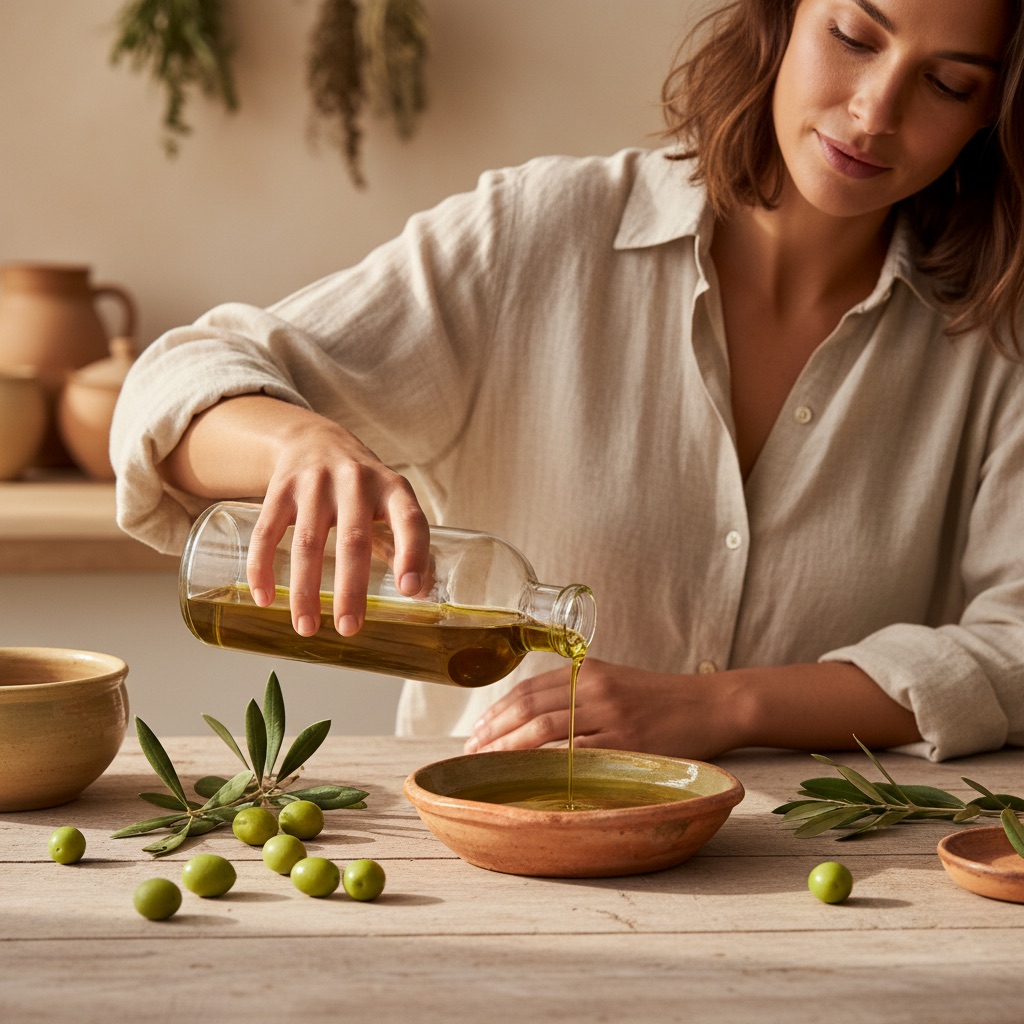
There is a quiet problem on the olive-oil shelf, and it is not whether the oil is "healthy." It is that the two most important words on the bottle — extra virgin — are, on their own, one of the least reliable claims in your supermarket. Extra-virgin olive oil is among the most adulterated and mislabeled foods sold at retail, and a bottle can wear those words while holding an oil that a trained taste panel would reject. The front label rarely tells you what you most need to know, and that is exactly where money — and the whole point of buying good oil — gets wasted.
This guide fixes that. By the end you should be able to pick up any bottle of olive oil, judge whether the "extra virgin" claim is backed by anything checkable, read the one date that actually predicts freshness, and tell from a single taste whether what you bought is alive or already gone. We do not rank specific products, because we have not tested them yet, and a ranked list of bottles nobody opened is the thing we built this site to avoid. What you get is the method, so you can judge any bottle yourself.
A note first: this is shopping and kitchen guidance, not a health claim. Olive oil is a food, not a supplement, so there is no safety section to clear with a clinician — the stakes are your money and your cooking. What makes olive oil tricky is not danger; it is that quality is invisible through the glass, and the label is doing quiet work to keep it that way.
What "extra virgin" actually means — and why the label isn't proof
"Extra virgin" is not marketing fluff; it is a defined grade. Under the U.S. Department of Agriculture's voluntary standards for olive oil — revised in 2010 after sitting essentially unchanged since 1948 — U.S. Extra Virgin Olive Oil must have a free fatty acid content of not more than 0.8 grams per 100 grams, a "median of defects equal to zero," and a "median of fruitiness greater than zero" (USDA Agricultural Marketing Service). In plain terms: it has to be chemically clean, have zero detectable sensory defects, and actually taste of olives. That last part is judged by a trained human panel, not a machine — which is the crux of the whole problem.
Here is the catch the label hides. Those USDA standards are voluntary, and the grade name carries the "U.S." prefix only when a product has been officially sampled and graded by the AMS — something most bottles on the shelf have not. So when an imported bottle simply prints "extra virgin," that is the producer's unverified claim, not a graded result. The standard exists, in the USDA's own framing, to "promote truth in labeling," but printing the words is not the same as passing the test.
How often does the claim fail? In 2010, researchers at the UC Davis Olive Center, working with Australian collaborators, bought oils labeled "extra virgin" off California supermarket shelves and ran them against the international and U.S. standards. They found that 69 percent of the imported oils failed to meet the extra-virgin standard, compared with about 10 percent of the California-produced oils (UC Davis). As the lead researchers put it, "The oils that failed in our tests had defects such as rancidity — many of these oils just did not taste good." The failures traced to "oxidation due to elevated temperature, light and or aging," "adulteration with cheaper refined olive oil," and "poor-quality oils made from damaged and overripe olives."
The single most useful line from that work has a very practical edge: the team found that "the analytical chemistry methods established by the International Olive Council and the U.S. Department of Agriculture often do not detect defective oils that fail extra virgin sensory standards." Even the lab tests can miss a bad oil that a human tongue catches instantly — which is why the taste test at the end of this guide is the most powerful tool a shopper has. (One fair caveat: sensory grading is a trained-panel judgment, and the industry has pushed back on headline failure rates as partly subjective. The honest reading is not "most olive oil is fraud" — it is "the words alone don't prove the grade," which is all you need to shop carefully.)
The decision the label hides: freshness, packaging, and proof
If "extra virgin" alone isn't proof, what is? Three things the marketing rarely shouts about, because none of them flatter a tired oil.
The first is age, the fact that reframes everything: unlike wine, olive oil does not improve with age — it only declines. The North American Olive Oil Association puts it bluntly — an olive oil "was always better yesterday," its flavors mellowing and fading with time rather than deepening (NAOOA / About Olive Oil). It is a fresh-pressed fruit juice that happens to be a fat, with a clock running from the moment it is made.
The second is how that age is disclosed. Most bottles carry a "best by" date, which the NAOOA notes can sit up to two years out from bottling — a date that tells you when the producer guesses the oil will still be passable, not how fresh it was to begin with. A harvest (or "pressed on") date is far more honest, because it anchors to the actual event that matters. The California Olive Oil Council advises using extra-virgin oil "within 18 – 24 months of harvest" and warns that because some bottles list expiration dates beyond two years, "the harvest date [is] crucial for ensuring freshness" (COOC). A bottle that proudly prints a recent harvest date is a bottle whose maker has nothing to hide about its age.
The third is packaging, which is quietly a freshness decision. Light, heat, and air are what turn good oil rancid, so the container is part of the product. The COOC's guidance is direct: extra-virgin olive oil "should be packaged in dark glass, tin or bag-in-a-box to cut down on light exposure," and you should avoid bottles "displayed on top shelves where they receive direct light" (COOC). A clear glass bottle glowing under supermarket spotlights is oxidizing as you watch.
Comparing two bottles on what actually matters
The price tag is the least informative thing on the shelf. Here is the lens that is more useful — the same bottle judged by the signals that predict quality.
| What you can read | Weak signal | Stronger signal |
|---|---|---|
| The grade claim | "Extra virgin" and nothing else | "Extra virgin" plus a verifiable seal (COOC, NAOOA) or named single estate |
| The date | A far-off "best by" only | A recent harvest / pressed-on date (ideally within ~12–18 months) |
| Packaging | Clear glass, under store lights | Dark glass, tin, or bag-in-box |
| Origin | "Product of several countries" / "bottled in…" | Single country, region, or estate named |
| What the price buys | Cheapest large clear bottle | Fresh, dated, light-protected oil you'll use before it fades |
None of this is about paying the most. A big, cheap clear bottle of anonymous blend with a distant best-by date can be the more expensive purchase, in the only sense that counts, than a smaller dark bottle with a recent harvest date you will actually finish while it is good. Price tells you almost nothing until you divide it by freshness and verifiability.
The five checks that separate a real bottle from a hopeful one
Once you know what matters, five label checks do the work. Each has a reason and a quick way to run it.
1. Is there a harvest date — not just a "best by"?
Because olive oil degrades from the moment it is pressed and does not improve with age, so the age of the oil is the strongest predictor of how it will taste (NAOOA). How: look for a "harvest" or "pressed on" date and prefer the most recent one you can find; the COOC's window is within 18–24 months of harvest, and fresher is better (COOC). If a bottle shows only a far-off "best by," treat that as the producer declining to tell you the thing you most want to know.
2. Is it in light-blocking packaging?
Because light, heat, and air oxidize oil, and clear glass under store lighting accelerates exactly that. How: choose dark glass, tin, or bag-in-box, and skip bottles sitting on a brightly lit top shelf (COOC). Packaging is not aesthetics here; it is preservation.
3. Is the "extra virgin" claim backed by a seal or real origin — not just the words?
Because the grade name is an unverified claim unless something stands behind it, and most retail bottles were never officially graded (USDA AMS). How: look for a named program you can confirm. A COOC seal means the oil "passed chemical laboratory analysis and sensory panel assessment" and is from a recent California harvest (COOC); a North American Olive Oil Association (NAOOA) Certified mark is another named program you can confirm on the association's own site. A logo you can check on the certifier's own site is evidence; the bare words are not.
4. Is the origin specific — or vague?
Because single-estate or single-region oil is traceable and harder to dilute, while "product of several countries" is the phrasing that makes blending and adulteration easy to hide. How: read past the front label to the origin statement. A named country, region, or estate is a quiet confidence signal; a vague multi-country blend with a domestic "bottled in" line is two unknowns stacked together.
5. Does it pass the taste test once you open it?
Because a shopper's tongue catches defects that even the lab methods miss, per the UC Davis finding above. How: fresh, well-made extra-virgin oil tastes fruity, with a real bitterness and a peppery catch at the back of the throat — sometimes a cough. Those are positive attributes, not flaws: bitterness and pungency "are two sensory attributes that have traditionally been related to the total phenolic content," and the peppery throat catch comes from oleocanthal and related phenolic compounds (Foods, 2025, peer-reviewed). If your oil is flat, greasy, waxy like crayon, or smells musty or like fermented olives, it is old or defective — return it.
Red flags that mean leave it on the shelf
- "Extra virgin" with no seal, no harvest date, and a clear bottle. Three unknowns at once — the words are carrying all the weight, and the words don't prove the grade.
- Only a far-off "best by" date. It tells you when the producer hopes the oil is still drinkable, not how fresh it was when bottled.
- "Product of several countries" with a vague "bottled in" line. The phrasing that makes blending and dilution easy and origin impossible to trace.
- A clear bottle sitting under bright store lights. It is oxidizing in front of you; light is one of the things that ruins oil (COOC).
- It tastes flat, greasy, or musty. No bitterness, no pepper, no fruit. The grade claim has already failed the only test you can run at the table.
Putting it together: two bottles
Here is the method on two bottles you might meet. These are illustrative, not real products.
Bottle A — leave it:
Extra Virgin Olive Oil — 1 L Clear glass · "Product of Italy, Spain, Greece, Tunisia" Best by: 2028
Verdict: weak on every axis that matters. The "extra virgin" claim stands alone with no seal (check 3), the multi-country line hides origin (check 4), the clear bottle invites oxidation (check 2), and a 2028 best-by with no harvest date tells you nothing about freshness (check 1). The big affordable bottle is the trap.
Bottle B — the stronger bottle:
Extra Virgin Olive Oil — 500 mL Dark glass · Single estate, Coratina, Puglia Harvested: November 2025 · COOC-style sensory + chemistry seal
Verdict: stronger. It states a recent harvest date (1), uses light-blocking dark glass (2), backs the grade with a verifiable seal (3), and names a single origin (4). That does not guarantee you will love it — but it is honest enough to evaluate, and when you open it, check 5 (fruity, bitter, peppery) confirms the rest.
Storing and using it: the bottle is not décor
Buying a fresh oil and then ruining it at home is a common, avoidable waste. The same enemies — light, heat, air, time — keep working in your kitchen.
Store olive oil "away from light, air and heat," in a cool, dark cabinet — "never near the stove," and not in the refrigerator, where condensation can cause problems (COOC). The sunny windowsill and the shelf above the cooktop are the two worst spots in most kitchens. Because oxidation accelerates once the bottle is opened, treat opened oil as a fresh product: the COOC suggests using it within a few months of opening, and the NAOOA likewise advises consuming an opened bottle within roughly two to three months (NAOOA). So buy a size you will actually finish in that window — a bargain magnum you nurse for a year is no bargain if the last two-thirds taste of nothing.
Why we haven't named a product
You will notice we have not told you which olive oil to buy. That is deliberate. We have not tested specific products, and a ranked list of bottles nobody opened is the thing we built this site to avoid. Our reviews come from buying at retail, using for a stated window, tasting and logging what we found, and disclosing every link — the full method is on our how we vet page, and our affiliate disclosure explains how we handle any links. When olive-oil reviews publish, they will appear under Kitchen with a real method beside each, and any "where to buy" link will be marked for what it is. Until then, the five checks above — harvest date, packaging, a verifiable seal, specific origin, and the peppery taste test — are the same lens we use, and they are enough to protect your money, and your cooking, today.