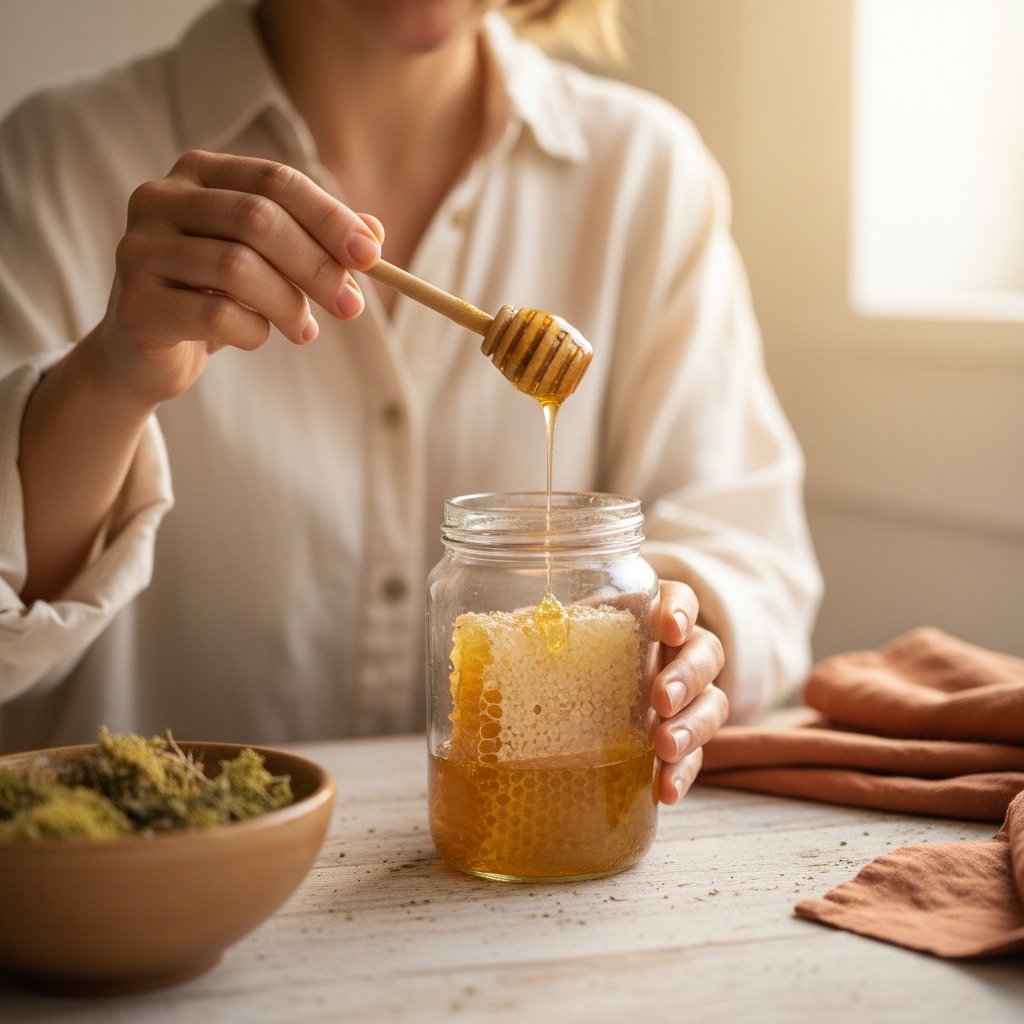
There is a quiet problem on the honey shelf, and it is not whether honey is "good for you." It is that a jar labelled "honey" can be part honey and part cheap sugar syrup — diluted to stretch a valuable food with something that costs a fraction as much. The label is supposed to tell you when that has happened, in words most shoppers have never been taught to read, and the gap between the front-label promise and the jar's actual contents is exactly where money quietly leaks out.
This guide closes that gap. By the end you should be able to pick up any jar, work out whether "raw" and "unfiltered" mean anything here, read the origin and ingredient clues that flag a possible adulteration problem, know why a crystallized jar is usually a good sign rather than a spoiled one, and decide if it deserves your money. As with everything we publish, we do not rank specific products — we have not tested them, and a ranked list of jars nobody opened is the thing we built this site to avoid. What you get is the method.
A note first, and one safety fact up front because it is the kind you cannot afford to skim past. Honey is a food, not a supplement, so most of this is shopping guidance about quality and value rather than medical advice. The exception is babies: the CDC advises against giving honey to any child under 12 months, in any form, because of the risk of infant botulism (CDC). That rule is absolute and "raw," "organic," or "local" does not change it — there is a fuller safety section near the end, but if a baby is in the picture, that line is the one to remember.
What "raw" honey is — and what it isn't
Start with the words on the front, because they carry less than they imply. Honey on a shelf is usually described in one of three ways, and the differences are about processing, not about a brand being "purer" than another.
- Raw honey is, in the National Honey Board's words, "honey as it exists in the beehive or as obtained by extraction, settling or straining without adding heat" (National Honey Board). In practice that means it is strained only enough to take out wax and large debris before bottling — not pasteurized and not finely filtered — so it keeps more of its natural pollen and fine particles.
- Filtered honey is passed through a fine filter, often after gentle warming, to remove pollen, fine particles, and air bubbles. The Honey Board notes that those suspended particles and air bubbles are what speed up crystallization, so filtering keeps honey clear and liquid on the shelf for much longer (National Honey Board) — but the same fine filtering that delays granulation also strips out the pollen that makes raw honey distinctive.
- Pasteurized honey is heated mainly to slow crystallization and extend shelf life, which makes it smooth and pourable but can affect some heat-sensitive enzymes.
Here is the honest part. "Raw" and "unfiltered" are not strictly regulated terms in the US — there is no official US federal definition of "raw" honey, a point the National Honey Board makes plainly when it offers its own working definition (National Honey Board). So the words signal an intent (not heated, not finely filtered) rather than a certified standard. That does not make them meaningless; minimally processed honey genuinely does retain more pollen. It does mean the words alone are a starting point, not proof — you read the rest of the label to confirm the jar lives up to them.
And while raw honey is real, the health claims stacked on top of it usually are not. "Superfood," "immune booster," "detox" — these run well ahead of the evidence. Raw honey is honey with less processing, worth buying for flavour and minimal handling. It is not medicine, and a jar that leans hard on cure-and-boost language is telling you more about its marketing than its contents.
The decision the label hides: is it all honey, and where is it from?
Behind the "raw" question sits a bigger one the front label works hard not to answer: is this jar entirely honey, and do you know where it came from? A peer-reviewed review of the problem puts it plainly — "honey is one of the foods most subject to adulteration and fraud" — and notes that the European Union, after a 2016 control plan found foreign sugars in 14% of the samples it analyzed, classified honey as "a food with a high risk of fraud" (Tsagkaris et al., 2022, Foods / PMC).
The way it happens is simple economics. Honey is valuable; sugar syrups from corn, rice, sugar beet, or cane are cheap. So a producer can dilute real honey with syrup — by adding it after harvest, or by overfeeding bees syrup so it ends up stored alongside genuine nectar — and sell the result as "honey" at honey prices. Because sugars are naturally present in honey to begin with, this is hard to detect; as the same review notes, detection techniques "fail to keep pace with the evolution of fraud" (PMC).
You cannot run a lab test in the aisle, but the label and the law give you two real tools. The first is the ingredient rule. Under the US Federal Food, Drug, and Cosmetic Act, a jar of only honey is labelled "honey" and needs no ingredient list. The moment another sweetener is added, FDA guidance is explicit: the product must be named a blend and the added sweetener declared. As that guidance puts it, a mix should be named "Blend of corn syrup and honey" (in order of predominance by weight), and "identifying a blend or a mixture of honey and another sweetener only as 'honey' does not properly identify the basic nature of the food" (FDA, Proper Labeling of Honey and Honey Products). Selling syrup-cut honey as plain "honey" is, under the Act, adulteration.
The second tool is origin. Single-source honey — one beekeeper, one region, one named floral type (clover, orange blossom, buckwheat) — is traceable in a way that a vague "packed from honey of more than one country" is not. That multi-country phrasing is not automatically fraud, but it is the opacity that makes dilution easy to hide, which is why it is treated as a flag. Keep it in proportion, though: when the FDA tested 102 samples (domestic and imported) in its FY25 program, only about 4% were violative (FDA FY25 honey sampling). Most honey on the shelf is real honey. The point is not paranoia — it is knowing which jars have earned your trust by being transparent.
Reading the jar at a glance
Once you know what you are looking for, a handful of label features do most of the work. This table is the scannable version of the checks that follow.
| What to look for | What good looks like | Red flag |
|---|---|---|
| Ingredient list | "Honey" — and nothing else | Corn syrup, "blend," or undeclared sweeteners |
| "Raw" / "unfiltered" | Stated and consistent with an opaque, pollen-rich jar | "Pure" or "natural" with no processing detail |
| Origin | One country, region, beekeeper, or named floral source | "Product of more than one country," no source |
| Crystallization | Granulated or cloudy is fine — often a good sign | Treating crystallized honey as "spoiled" |
| Claims | Plain food language | "Detox," "superfood," "cures," "boosts immunity" |
The five checks that separate a real jar from a hopeful one
Each check has a because — the reason it matters — and a how — the quick way to run it on the jar in your hand.
1. Does the ingredient list say only "honey"?
Because this is the single most decisive line on the jar, and US law puts it there for you. A true single honey lists one ingredient: honey. The instant a cheaper sweetener is added, FDA guidance requires the product to be named a "blend" and the syrup declared in the ingredient statement (FDA). How: read the ingredient list, not the front label. "Honey" alone is what you want. "Corn syrup," "rice syrup," "glucose syrup," or the word "blend" means you are buying something diluted — which can be fine if that is what you intended, but it should never cost the same as pure honey.
2. Is "raw" or "unfiltered" stated — and does the jar back it up?
Because these words point to less processing and more retained pollen, but they are not strictly regulated, so they need corroboration. The National Honey Board's own working definition of raw — honey as it comes from the hive, without added heat — exists precisely because there is no federal standard to enforce (National Honey Board). How: look for "raw" or "unfiltered" stated plainly, then sanity-check it against the jar: minimally filtered honey is often slightly cloudy or opaque and prone to crystallizing, rather than perfectly clear and permanently liquid. A jar that says "raw" but looks like glass-clear syrup that never granulates is worth a second look. "Pure" and "natural" on their own are marketing words, not processing claims.
3. Is the origin transparent?
Because traceable honey — a single country, region, beekeeper, or floral source — is the honey hardest to quietly dilute, while vague multi-country blends are the easiest. Origin transparency is the practical antidote to a fraud-prone category. How: look for a specific source: a country, a region, a named beekeeper, or a single floral type. "Product of more than one country" with no further detail is not proof of a problem, but it is the opacity that makes adulteration easy to hide — treat it as a reason to want a better-documented jar, especially at a suspiciously low price.
4. Is crystallization treated as normal — not as a defect?
Because crystallization is a natural physical change, not spoilage, and raw honey crystallizes sooner precisely because it still contains the pollen and fine particles that crystals form around. USDA standards even recognize honey as liquid, crystallized, or partly crystallized — all legitimate states (USDA, Standards for Grades of Extracted Honey). How: do not reject a jar for going thick or grainy, and be mildly suspicious of honey sold as never crystallizing, since that usually means heavier filtering and heating. If your own jar granulates, it has not gone bad — warm it gently and it re-liquefies.
5. Are the claims honest food claims?
Because honey is a food, and a jar that promises to "detox," "boost immunity," or act as a "superfood cure" is selling hype the evidence does not support. How: prefer plain language — floral source, region, raw or filtered, taste notes. The more a jar leans on disease-adjacent or miracle language, the less its energy went into the honey. Honest honey does not need to promise to fix you.
Red flags that mean put the jar back
- An ingredient list with corn syrup, rice syrup, or "blend." Diluted honey sold at honey prices is the core thing this guide exists to catch.
- "Honey" on the front but added sweeteners in the ingredients. Under the FD&C Act that is mislabeled — and it should never command a single-honey price.
- Vague, multi-country origin at a price well below the going rate. The combination — no source plus a too-good price — is the classic adulteration signature.
- "Never crystallizes" sold as a virtue. Usually a tell for heavier heating and filtering, not for quality.
- "Detox," "superfood," "cures," "boosts immunity." Hype language doing the work the honey should be doing.
Putting it together: two jars
The method on two jars you might meet on the same shelf, at the same price. These are illustrative examples to show the decision, not real products.
Jar A — put it back:
"Pure Natural Honey" — 32 oz Ingredients: Honey, corn syrup "Boosts immunity · Never crystallizes" Packed from honey of more than one country
Verdict: weak, and arguably mislabeled. The ingredient list reveals corn syrup, so it is a blend wearing a single-honey front label (check 1); the origin is vague multi-country (check 3), "never crystallizes" hints at heavy processing (check 4), and "boosts immunity" is hype (check 5). At single-honey money, it is the expensive jar.
Jar B — the stronger jar:
"Raw Wildflower Honey" — unfiltered Ingredients: Honey Single apiary, [named region] "May crystallize over time — gently warm to re-liquefy"
Verdict: stronger. One ingredient (check 1), "raw/unfiltered" consistent with the jar (check 2), a single named source (check 3), crystallization framed honestly (check 4), no miracle claims (check 5). Still down to your taste and budget — but honest enough to evaluate.
Safety: the one rule that isn't optional, and a couple of footnotes
Most of honey's "safety" is really quality, but one point is genuinely non-negotiable:
- Never give honey to a baby under 12 months — full stop. The CDC advises against giving honey to any child younger than one year, including in food, water, formula, or on a pacifier, because honey can contain spores of the bacteria that cause infant botulism, a medical emergency (CDC; see also CDC botulism prevention). "Raw," "organic," and "local" make no difference — the spores are not removed by any of those, and the only safe rule is no honey of any kind before the first birthday. After 12 months, a child's gut can handle the spores and honey is fine.
- It is still sugar. Honey is roughly 80% sugars, so if you manage diabetes or watch added sugars, it counts like any other sweetener — "natural" does not change how it behaves in your bloodstream.
- Rare pollen sensitivities. A few people react to the pollen and plant compounds in raw, unfiltered honey; with known severe pollen or bee-product allergies, introduce a new honey cautiously.
For everyone past their first birthday and without those concerns, honey is simply a food — the rest of this guide is about getting an honest one for your money.
Why we haven't named a product
You will notice we have not told you which honey to buy. That is deliberate. We have not tested specific jars, and a ranked list of products nobody opened is exactly the thing we built this site to avoid. Our reviews come from buying at retail, using the product over a stated window, logging what we actually found, and disclosing every link — the full method is on our how we vet page, and our affiliate disclosure explains how we handle any links. When honey reviews publish, they will appear under Kitchen with a real method beside each, and any "where to buy" link will be marked for what it is. Until then, the five checks and the one hard safety rule above are the same lens we use — and they are enough to protect your money, and a baby's safety, today.